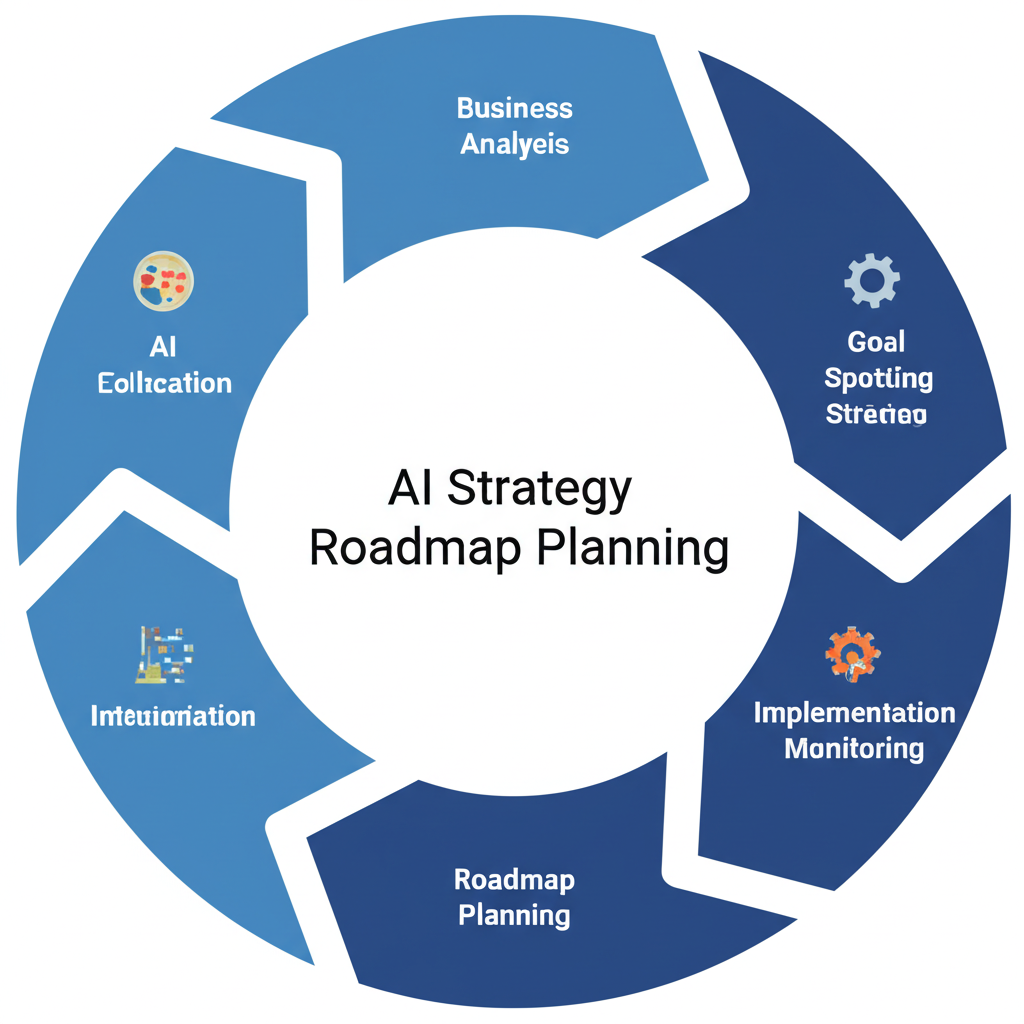
In an era where artificial intelligence (AI) is integral to business operations, ensuring that AI systems align with organizational values and goals is paramount. Neftaly’s AI Alignment Consulting service focuses on developing and implementing strategies that ensure AI technologies are aligned with your business objectives, ethical standards, and regulatory requirements.
Core Services:
AI Strategy Development: Crafting comprehensive AI strategies that align with your business goals, ensuring that AI initiatives drive value and innovation within your organization. Vation Ventures
AI Governance Frameworks: Establishing policies and structures to oversee AI development and deployment, ensuring ethical considerations and compliance with industry standards. Centric Consulting
AI Integration: Integrating AI solutions into existing business processes, enhancing efficiency and decision-making capabilities. Improving
Ethical AI Implementation: Implementing AI systems that adhere to ethical guidelines, promoting fairness, transparency, and accountability. Huron Consulting Group
Why Choose Neftaly:
Expertise in AI Alignment: Our consultants possess deep knowledge in aligning AI technologies with business strategies and ethical standards.
Tailored Solutions: We provide customized strategies that align with your organization’s specific goals and challenges, ensuring relevance and effectiveness.
Proven Impact: Neftaly has a track record of successfully assisting clients in aligning their AI initiatives with business objectives, leading to enhanced performance and compliance.
Partner with Neftaly to ensure your AI systems are aligned with your business goals and ethical standards, driving sustainable growth and innovation.
What “Neftaly Revolutionizing AI Governance Consulting” Means
This consulting offering is about helping organizations not just establish AI governance, but revolutionize it: building governance that is adaptive, scalable, deeply embedded, ethically strong, regulatory-compliant, and innovation-friendly. It aims to shift governance from being a checkbox or afterthought to being a strategic enabler: ensuring AI systems are trustworthy, transparent, fair, safe, and aligned with both organizational and societal values.
“Revolutionizing” implies pushing beyond conventional frameworks to anticipate new risks (agentic AI, autonomous systems, generative models, cross-jurisdiction regulatory complexity etc.), embedding governance throughout the AI lifecycle, and fostering continuous improvement & stakeholder trust.
Why It Matters / Trends & Evidence
Here are some recent trends and findings that show why this kind of elevated governance is urgent:
The Unified Control Framework (UCF) (2025) is emerging from research as a way to integrate risk management + regulatory compliance via a unified set of controls. arXiv
Global regulatory activity is increasing: EU AI Act, national AI strategies and frameworks, indexes like AGILE Index that benchmark countries’ AI governance maturity. arXiv+2AI21+2
There is a growing understanding that traditional AI governance (fairness, transparency, accountability) must expand to cover new risk domains: autonomous agents, large language models, multi-jurisdiction compliance, environmental impact, data ethics etc. arXiv+1
Best practices are pointing to frameworks that are not only principle-based but operational: mapping across the lifecycle of AI (design, training, deployment, monitoring), with concrete controls, auditability, and traceability. AI21+1
Core Components & Capabilities
To “revolutionize” governance, Neftaly should include these modules / capabilities:
Component
What It Should Cover
Governance Strategy & Visioning
Define what “good governance” means for the organization: values, ethical principles, risk tolerance, compliance vision; alignment with mission / strategy.
Risk & Compliance Landscape Mapping
Identify legal/regulatory requirements across regions / industries; map emerging risks (bias, fairness, explainability, privacy, malicious use, governance of autonomous/agentic AI etc.); include external trends.
Unified Control Framework Implementation
Possibly adapting or constructing controls from frameworks such as the UCF, or combining NIST, EU AI Act, ISO, etc., into a coherent, actionable control set.
Lifecycle Governance Model
Embed governance across full AI system lifecycle: data collection & quality, model design, training, validation, deployment, monitoring, decommissioning; include human oversight & feedback loops.
Ethics, Explainability & Transparency
Define policies & tools for responsible AI: fairness, bias mitigation, explainability, auditability; define what model / system transparency is required; ensuring end users / impacted parties have visibility.
Operational Controls & Technical Safeguards
Testing & validation practices, bias audits, robust validation, adversarial risk, privacy preserving techniques, data lineage/tracking, guardrails, monitoring of drift.
Governance Structure, Roles & Accountability
Steering committees or AI governance boards; data / AI ethics officers; roles & responsibilities across legal, product, engineering, compliance, and leadership for decisions & oversight.
Policy & Regulatory Compliance
Ensuring alignment with current laws & regulations (e.g. EU AI Act, US state laws, industry regulations), as well as anticipating future regulation; gap analyses; compliance audits.
Select or build tools for monitoring, explainability, bias audits, data lineage, drift detection; integrate with workflows; policy as code if possible.
Phase 5: Pilot / Implementation (~2-4 weeks)
Apply governance model and controls in pilot projects or specific AI systems; conduct audits / tests; validate policies & controls; collect feedback.
Build dashboards; define metrics; set feedback mechanisms; train teams; embed governance in development practices; leadership engagement.
Phase 7: Scale & Sustain (ongoing)
Expand governance to more systems; refine controls; update with regulatory changes; maintain audit cycles; continuous improvement.
Differentiators & Value Proposition
What will make Neftaly’s “Revolutionizing AI Governance” particularly valuable / stand out:
Offering forward-looking governance that anticipates emerging dynamics (agentic AI, autonomous decision making, cross-border regulatory complexity, model safety etc.), not just compliance with what’s already law.
Use of unified control frameworks (like UCF) to reduce duplication, provide consistency across jurisdictions.
Deep integration with product / engineering workflows so governance is not a bottleneck but accelerates trust & adoption.
Strong emphasis on transparency, explainability, and stakeholder trust—making governance visible inside & outside the organization.
Automation and scalable tooling: policy-as-code, automated audits, monitoring, drift detection etc.
Flexible governance structures: able to adapt to regulation changes, model / data shifts, emerging risks.
Culture & ethics embedded: training, awareness, leadership buy‐in so governance is not just rules but a lived practice.
Risks & Challenges & Mitigations
Risk / Challenge
Mitigation Strategy
Regulatory uncertainty or changing requirements across jurisdictions
Stay abreast via regulatory scanning; build frameworks that are modular and adaptable; engage legal & policy experts locally.
Resistance from engineering teams or product teams (can see governance as a blocker)
Embed governance early; involve technical teams in policy design; ensure governance adds value (e.g. risk reduction, trust, fewer reworks); pilot to show benefits.
Low awareness or low culture of ethics / governance in organization
Leadership sponsorship; training & awareness; communication; incentives; visible examples.
Supporting Research / References
The Unified Control Framework (UCF): integrates risk taxonomy, policy requirements, and a coherent set of controls that map to multiple regulatory regimes. arXiv
AGILE Index: tracks global AI governance maturity across countries; useful benchmark for what “good practice” looks like globally. arXiv
Hourglass Model of AI Governance: from layers of environmental → organizational → AI-system level that flow governance requirements; helpful for thinking how policies/principles translate into operational practices. Reddit
Sample Deliverables
Here are example outputs you might deliver under Neftaly Revolutionizing AI Governance Consulting:
AI Governance Maturity Assessment Report
Unified Control Framework (tailored, with control library)